
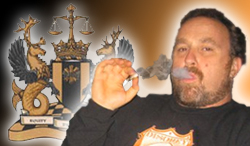
 CANNABIS CULTURE – The latest battle in the Canadian courts over the right to use marijuana for religious purposes – the seemingly immaculate Charter Challenge case of cannabis historian Chris Bennett – was struck down by a Federal Judge this week.
Bennett, a reverend of the Church of the Universe, believes the cannabis plant is the Tree of Life as described in the Bible and doctrines of many other religions, and uses marijuana to invoke his own revelatory experience. He’s written three books focusing on the use of cannabis and other drugs as entheogens: psychoactive substances used for religious, spiritual, or shamanic practice.
Bennett applied to the Minister of Health for an exemption to the Controlled Drugs and Substances Act so he could practice his religion without the fear of arrest, property seizure, or the loss of the custody of his son. His request was denied with only the explanation that it “would not be in the public interest.”
After applying for a judicial review, he was granted a court hearing and attended the proceedings on November 8 and 9.
The hearing took place in a downtown Vancouver Federal courtroom and was notably odd, thanks to the eccentric Judge Michel Shore, who made several indecipherable statements and didn’t seem to be understand – or to be interested in – parts of the argument of Bennett and his attorney Kirk Tousaw.
Prosecutors argued essentially that Bennett’s use of cannabis has nothing to do with religion; that cannabis is a dangerous, cancer-causing substance that often leaves chronic users with permanent brain damage; and that granting Bennett his exemption from the law would “open the floodgates,” legalizing marijuana to anyone who claimed to use it for religious purposes.
Read a detailed account of Bennett’s court hearing from Cannabis Culture.
After taking only a few days to consider the case, the Judge released his decision on November 15.
Judge Shore ruled against Bennett, accepting virtually the entire argument of government prosecutors, agreeing that Bennett’s use of marijuana was secular and that granting him an exemption might cause the “detriment of the collectivity” of the Canadian people.
“It is not for a Court to deny or affirm a revelatory experience,” the Judge wrote in his judgement. “The revelatory experience exists, in and of itself. It is neither to be denied nor confirmed by law or reason. … Law is formulated in its intention for the collectivity of individuals, for society as a whole; however, the revelatory experience, which is individualistic, is in its own realm. The law is formulated by the legislative branch for the collectivity, while safeguarding the individual inasmuch as possible, when that is not to the recognized detriment of the collectivity as a whole; and, therefore, the judiciary must not do otherwise, but interpret the collective legislative will, which cannot satisfy every individual.”
Read the Judge’s entire 54-page REASONS FOR JUDGMENT AND JUDGMENT.
Bennett told Cannabis Culture he thought the ruling was “obviously unfair” and that most of Judge’s decision was “just cut and pasted from the prosecutions argument.”
“It just goes to show what a crap-fest the whole Canadian court system is,” Bennett said, “the bottom line is that decisions are supposed to be based on the supremacy of God and The Law – well they just throw that right out the window.”
Bennett’s lawyer Kirk Tousaw told CC his client plans on appealing the decision based on several factors.
“I think the record did not support the finding of fact that Chris’s religious belief was really just secular belief in disguise,” he said. “I think that is unsupported by the record. I also believe the Judge applied the wrong standard of reviewing to what is essentially a question of law with respect to what the charter protects. We are also going to be appealing the refusal by the court to allow us to introduce evidence of the government’s conditional approval of an exemption of ayahuasca for religious purposes.”
Tousaw said Judge Shore’s claims that it’s not the courts role to “deny or affirm a revelatory experience” were not in harmony with past court judgements.
“My view is that the Supreme Court of Canada made quite clear that that is exactly the sum and substance and scope of the court’s roll – to make a determination as to the sincerity of the individuals belief – and the court seems to instead take on the role of judging the validity of the religious belief and indeed whether or not Chris’s belief system appropriately constituted any religion. In my view, as I explained to the Judge in both written and oral submissions, that is emphatically not the role of the court and we certainly will make that a principle focus of the appeal.”
During the hearing, Judge Shore repeated several times that his decision would be harmonious with either entirely what the prosecution said in their memorandum of law or entirely what Bennett and Tousaw said in their memorandum of law.
“In my view, the idea that you had to fully accept one side or the other was not necessarily an appropriate consideration,” Tousaw said. “Even the test that the Supreme Court of Canada set out for determining whether religious beliefs have been violated involved a number of factors. Conceivably the judge could find for or against each party on each individual factor, it didn’t have to be one or the other.”
“The idea that he has to choose completely one way or completely the other is ludicrous,” Bennett said. “There are issues in several Sections, and those issues themselves break down, and the Judge doesn’t deal with any of that. It’s a crazy way to judge on such a complicated issue. I think he made his decision about which one he was going to pick before the trial even started and he was just trying to justify that choice throughout the trial, and he didn’t do a good job of that.”
Though they were discussed at length throughout the hearing, the Judged seemed to ignore Bennett’s accounts of his beliefs and his work with the Church of the Universe.
“He continually focused on my personal revelatory experience, like that was it,” Bennett said, “when I’ve been a member of a church that has been around for 42 years.”
As an extra burn, the Judge also ruled that Bennett would be responsible for the costs associated with his Charter Challenge.
“In civil cases in Canada we have a system colloquially known as a ‘loser pays’,” Tousaw said, “so if you lose the case you can have an order of cost made against you calculated on a specific scale – it’s not the actual costs but based on the amount of time for prep and trial – and it means, subject to appeal, that Chris is going to have to pay some amount of money to the government.”
Bennett said he will start the appeal process soon and is hopeful he will get a better result, though he has doubts about the fairness of the legal system.
“The Charter is not worth the paper it’s written on,” he said. “This was a kangaroo court with a nitwit judge. It’s ludicrous that this is what our tax dollars are paying for.”
Judge Shore is, coincidentally, the author of several books about religion and spirituality. The publisher’s description of his book At the Window states, “From the Sinai desert to ancient India. From Christianity to Islam, and Buddhism to Judaism, Michel Shore’s spirituality, mirrored in his writing, encompasses the universality of God. The result is a journey that is firmly rooted in both the soul and the soil. It is the journey of a spiritual voyager, searching within himself, and for all humankind.”
In this case, the Judge didn’t seem to search too deeply within himself before blockading the path of another spiritual voyager.
